
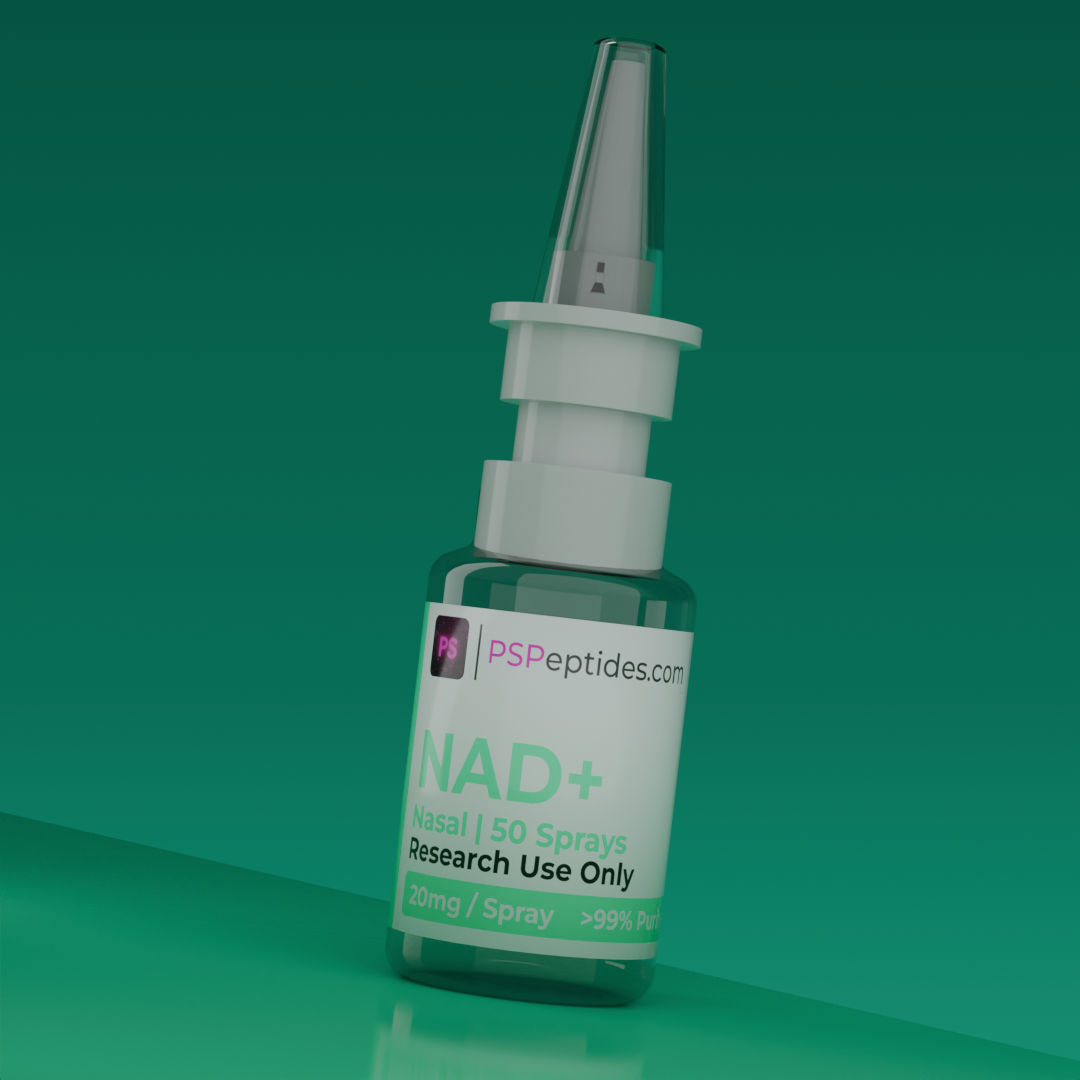
NAD+ spray from PSPeptides is a US-manufactured, third-party tested research formulation of nicotinamide adenine dinucleotide (NAD+), a coenzyme central to cellular energy metabolism. Each batch ships at 99%+ purity with a batch-specific Certificate of Analysis, giving researchers a consistent, verifiable starting material for laboratory work. This NAD+ spray is intended strictly for laboratory and research use, not for human consumption.
What Is NAD+ Spray?
NAD+ is a coenzyme present in every living cell, where it shuttles electrons during cellular respiration and acts as a required substrate for enzymes that regulate DNA repair, gene expression, and mitochondrial function. Because NAD+ is difficult to deliver intact across cell membranes, its handling and delivery format are active areas of laboratory interest.
This NAD+ spray delivers the coenzyme in a ready-to-use liquid format, removing the need for reconstitution and giving researchers a stable, easily measured starting point for their own experimental protocols.
Key Research Applications
- Cellular Energy Metabolism: NAD+ is studied for its role as an electron carrier during glycolysis, the citric acid cycle, and oxidative phosphorylation, all of which depend on a steady NAD+/NADH ratio.
- Sirtuin Pathway Research:Investigators use NAD+ to model activation of sirtuin (SIRT1-7) enzymes linked to metabolic regulation, mitochondrial biogenesis, and cellular stress resistance.
- DNA Repair Studies: NAD+ is a required substrate for PARP enzymes involved in genomic stability and DNA damage response research following induced cellular stress.
- Cellular Aging Models: Declining tissue NAD+ levels are a widely studied biomarker in cellular aging and senescence research across multiple organ systems.
Product Specifications
| Available Sizes | 500mg and 1000mg spray options |
| Purity | 99%+ (third-party HPLC and mass spectrometry) |
| Form | Liquid oral spray |
| Storage | Cool, dry location, protected from direct light |
| Testing | Batch-specific COA included |
| Origin | US manufactured |
A Brief History of NAD+ Research
NAD+ was first identified in 1906 by British biochemists Arthur Harden and William Young, who observed a heat-stable factor that accelerated fermentation in yeast extracts and called it “cozymase.” Later biochemists, including Otto Warburg, characterized its structure and clarified its role as a hydrogen-carrying coenzyme in cellular respiration during the 1930s.
Since then, decades of biochemistry research have mapped the pathways that build, consume, and recycle NAD+ within cells. This long research history is part of why NAD+ remains one of the most extensively studied coenzymes in metabolic science today, and why demand for a reliable NAD+ spray for laboratory use continues to grow.
Detailed Mechanism of Action
NAD+ exists in a constant redox cycle with its reduced form, NADH, shuttling electrons through glycolysis, the citric acid cycle, and oxidative phosphorylation. This electron transfer underpins the majority of cellular ATP production, making NAD+ availability a limiting factor for mitochondrial output in many experimental models.
Beyond energy metabolism, NAD+ is consumed as a substrate by three major enzyme families: sirtuins (SIRT1-7), poly-ADP-ribose polymerases (PARPs), and CD38. Sirtuins regulate transcription, mitochondrial biogenesis, and stress resistance; PARPs respond to DNA damage; and CD38 acts as the primary NAD+-degrading enzyme in mammalian tissue, a pathway of particular interest to aging researchers.
Because intact NAD+ does not cross cell membranes easily, a substantial body of research instead focuses on precursor molecules such as nicotinamide riboside (NR) and nicotinamide mononucleotide (NMN), which cells convert into NAD+ through the Preiss-Handler and salvage pathways. This NAD+ spray provides the finished coenzyme directly, which is useful for researchers who need the compound itself rather than a precursor for their study design.
Tissue NAD+ concentration is not static. It reflects a balance between synthesis through these pathways and consumption by NAD+-dependent enzymes, which is why researchers often measure both production and consumption pathways together rather than NAD+ levels in isolation.


Reviews
There are no reviews yet.